
This article is automatically translated.
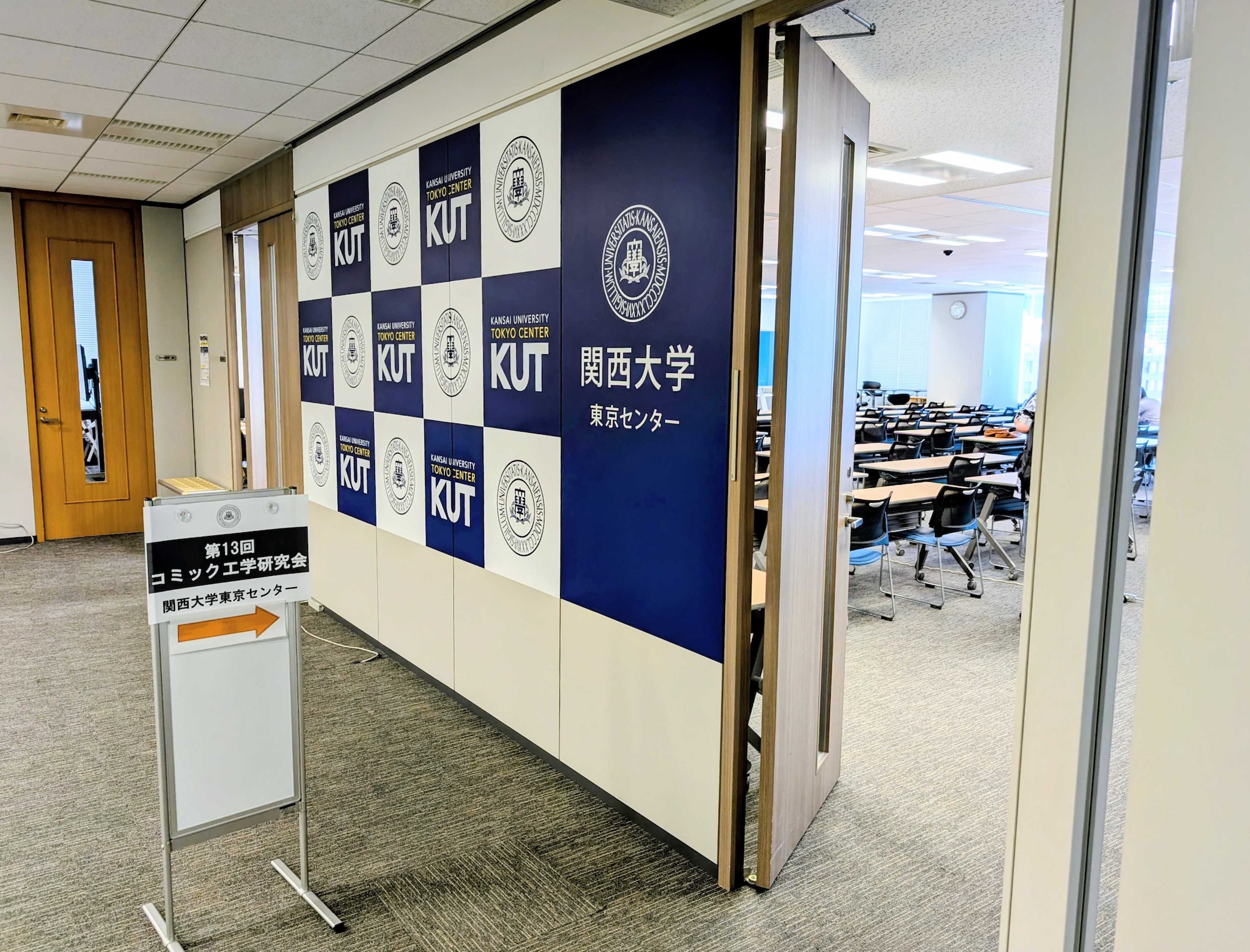
Kazuma Sasaki from DMV attended the 13th Comic Computing Workshop held at the Kansai University Tokyo Center on July 11, 2026, and gave a presentation during the Lightning Talk session. This follows our participation in the previous symposium.
This workshop featured a wide variety of presentations, ranging from manga analysis and automated generation to semiotic analysis of VTubers and research on Ningyo Joruri (traditional puppet theater).
DMV delivered two presentations in the LT session:
The first presentation focused on manga understanding using LLMs. At DMV, we are developing “MangaLens,” a manga understanding system that utilizes multimodal Large Language Models (LLMs) to analyze and summarize raw manga page images. In this talk, to test whether such a system can handle long-term context encompassing entire story arcs, we presented a case study using a Visual Question Answering (VQA) task on titles from Manga109-s. We also addressed how comprehension accuracy varies depending on the input modality—specifically, whether the pages are processed directly as “images” or as “text data via OCR.”
The second presentation was on panel/speech-bubble detection and reading-order estimation in manga page images. While existing studies often train custom deep learning models, we proposed a more practical approach leveraging general-purpose open-weight models. Specifically, we used Meta’s SAM3 to detect panel and speech-bubble regions, then applied heuristics based on their spatial relationships to estimate the reading order.
For more details, please see the slides below:
In comic computing, where manga is processed as data, techniques for automatically analyzing visual structures—such as storylines and panel layouts—serve as a crucial foundation. The venue saw lively presentations and discussions on manga analysis. Our two presentations fall directly into this domain: “MangaLens” addresses story structure analysis, while the second project focuses on visual structure analysis.
While machine learning techniques like LLMs continue to advance manga analysis, many challenges remain. Manga lacks strict, unified expression rules, making it difficult to comprehensively define its “reading” conventions. Furthermore, creators continuously innovate new techniques every day. To keep pace with these evolving trends, autonomous and continuous analysis methods capable of flexibly updating how they “read” manga may become increasingly necessary. We look forward to the next workshop!

Kazuma Sasaki

Kazuaki Hyoda
